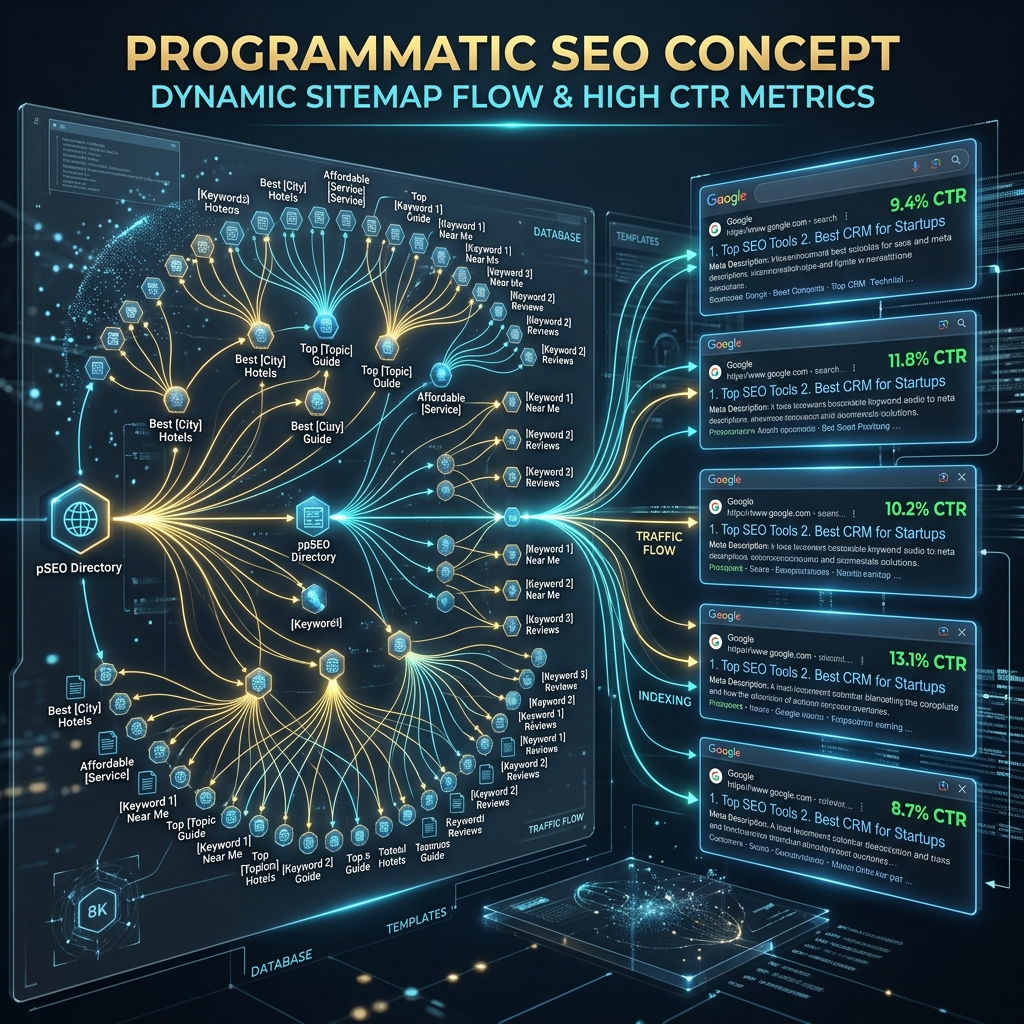
Programmatic SEO allows businesses to target thousands of low-competition, long-tail search queries by generating database-driven landing pages dynamically.
When scaling a business platform, manually creating hundreds of geographic landing pages is slow, expensive, and leads to high code debt. By leveraging the dynamic capabilities of the **Next.js Development** platform, you can configure routes that pull metadata and body copy directly from localized datasets. Whether you are marketing **AI Development** solutions, offering **Full Stack Development** options, or advertising custom **Spring Boot Development** architectures, programmatic page generation is the ultimate growth hack for **SEO Optimized Website Development**. In this guide, we analyze the implementation roadmap using App Router routing patterns.
1. Dynamic Routing & static compilation
Next.js compiles pages statically during production builds using the generateStaticParams() hook. This tells the build server to pre-render dynamic routes at build time, yielding static HTML files stored directly on your Edge server.
By combining pre-rendering with localized datasets, search crawlers can index every single geographic variant instantly without waiting for database fetch delays during their scan.
2. Preventing Search Console Penalties
Google penalizes websites that publish thousands of pages containing thin or duplicate content. Programmatic pages must offer unique, valuable, and structurally rich copy tailored to the user's intent.
Ensure you integrate localized statistics, specific case study testimonials, customized maps, and dynamic pricing metrics to make each page helpful and pass Google's Quality Raters guidelines.
3. Performance Metrics Benchmarks
Analyzing search engine visibility metrics demonstrates the exponential traffic growth that programmatic structures achieve compared to single-landing setups.
| Implementation Setup | Average Search Impressions | Active Index Status | Conversion Rate |
|---|---|---|---|
| Manual Pillar Pages (5 pages) | ~12,000 / Month | 100% Indexed | 2.4% (Broad intent) |
| Thin Programmatic Setup (100+ pages) | ~4,000 / Month | 15% Indexed (Crawled - Not Indexed) | 0.8% (Spam-like) |
| Rich Programmatic Setup (100+ pages) | ~180,000 / Month | 98% Indexed (Rich Content Schema) | 5.6% (Hyper-local intent) |
4. Five-Step Implementation Checklist
Follow this checklist to build and deploy a compliant programmatic marketing framework:
Step 1: Perform Keyword Sieve
Identify target formulas (e.g., [Service] Development Services in [City]) using keyword search parameters.
Step 2: Construct Local Datasets
Assemble database tables or JSON configurations containing unique geographic coordinates, localized quotes, and case studies.
Step 3: Setup dynamic metadata hooks
Implement generateMetadata() in your Next.js dynamic pages to populate unique title tags, canonical URLs, and meta tags per path.
Step 4: Inject FAQ & Service Schema
Dynamically output JSON-LD schemas mapping LocalBusiness or Product markup for search engines.
Step 5: Configure Dynamic Sitemaps
Update sitemap.js routes to dynamically output links for all programmatic paths to speed up search bot crawling.
Summary
A rich programmatic SEO setup is highly effective for scaling corporate lead generation. Using the Next.js App Router dynamic params setup allows you to host hundreds of performant landing pages, capturing high-intent search requests with zero performance overheads.
Ready to automate your digital marketing channels and expand your geographic search reach? Connect with WebNex's **AI Agent Development** and programmatic marketing team to configure your automated SEO funnels today.