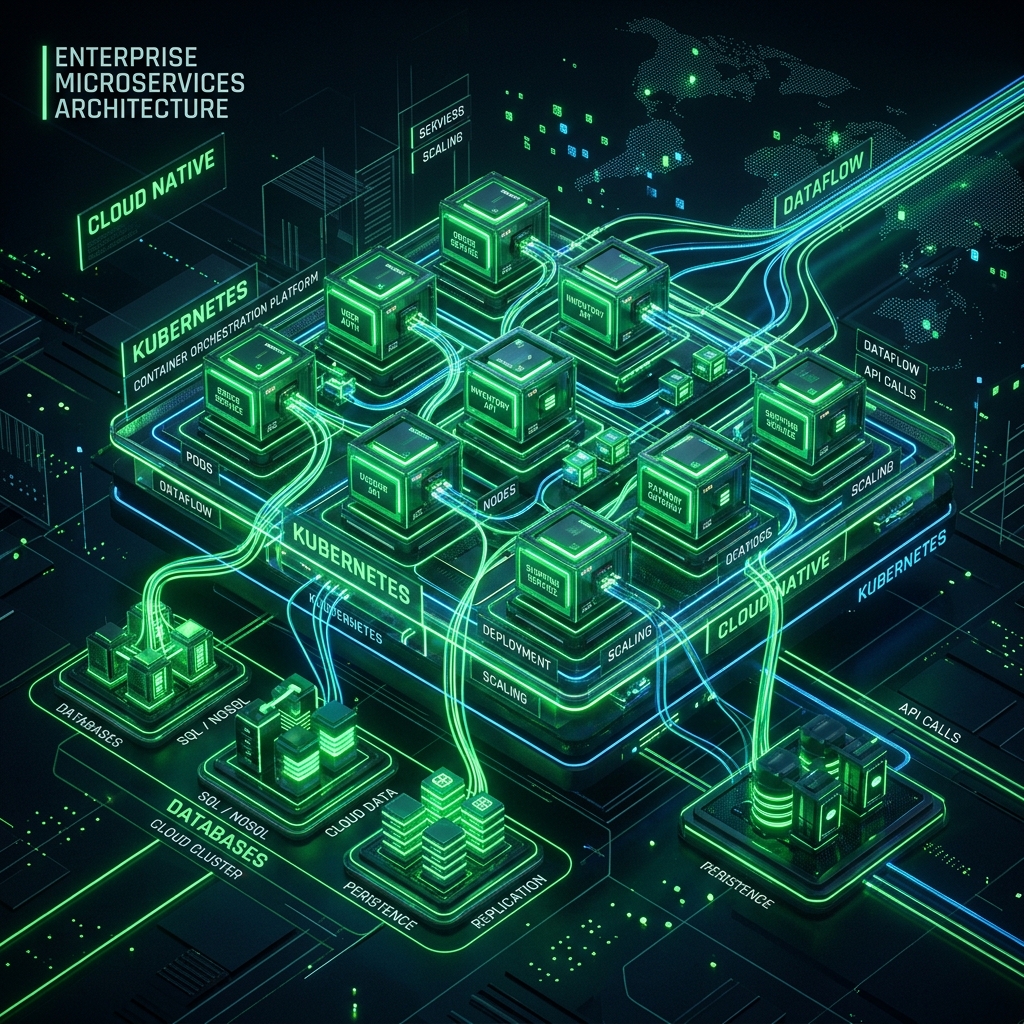
Monolithic web systems have become the primary bottleneck for scaling digital businesses. In this guide, we analyze how microservices architectures powered by Docker and Kubernetes enable high-velocity deployments.
When web systems fail under high-traffic spikes, the root cause is rarely the frontend layout; it is almost always backend thread exhaustion. By separating backend logic into independent microservices, startups and enterprise brands ensure that checkout pipelines, authorization checks, and product searches scale in isolation.
1. The Anatomy of Monolith Decoupling
Under a monolithic structure, any change to your catalog display requires a compilation of the entire application suite, exposing systems to release bugs and database locks. Microservices break this structure into independent logical units communicating via secure JSON REST or gRPC pathways.
By giving each microservice its own dedicated database (Database-per-Service pattern), database pool limits on checkout routes are isolated from database searches on catalog pages.
# Docker multi-stage build for microservices
FROM maven:3.8-openjdk-17 AS build
WORKDIR /app
COPY pom.xml .
COPY src ./src
RUN mvn clean package -DskipTests

FROM openjdk:17-jdk-slim
WORKDIR /app
COPY --from=build /app/target/auth-service-0.0.1.jar auth-service.jar
EXPOSE 8081
ENTRYPOINT ["java", "-jar", "auth-service.jar"]
2. Orchestrating with Kubernetes
Deploying 30 separate Docker containers requires centralized control. **Kubernetes (K8s)** acts as the orchestrator, managing container lifecycles, executing health probes, allocating memory limits, and managing internal load balancing.
If a specific payment service container encounters an Out-Of-Memory (OOM) error, Kubernetes automatically terminates the failed pod and provisions a clean replica within milliseconds.
| Scaling Method | Pros | Cons |
|---|---|---|
| Horizontal Scaling (HPA) | Highly elastic, replicates pods dynamically based on CPU/RAM thresholds. | Requires strict database connection pool tuning. |
| Vertical Scaling (VPA) | Increases resource limits for existing containers. | Limited by absolute node limits and triggers pod restarts. |
Summary
Microservices architectures require initial investments in pipeline configurations and K8s charts, but the dividend is infinite horizontal scalability. By decoupling application logics, you prepare your software to scale alongside traffic curves.
Looking to decouple legacy platforms? Connect with WebNex's cloud infrastructure team to scope your microservice migration roadmap.