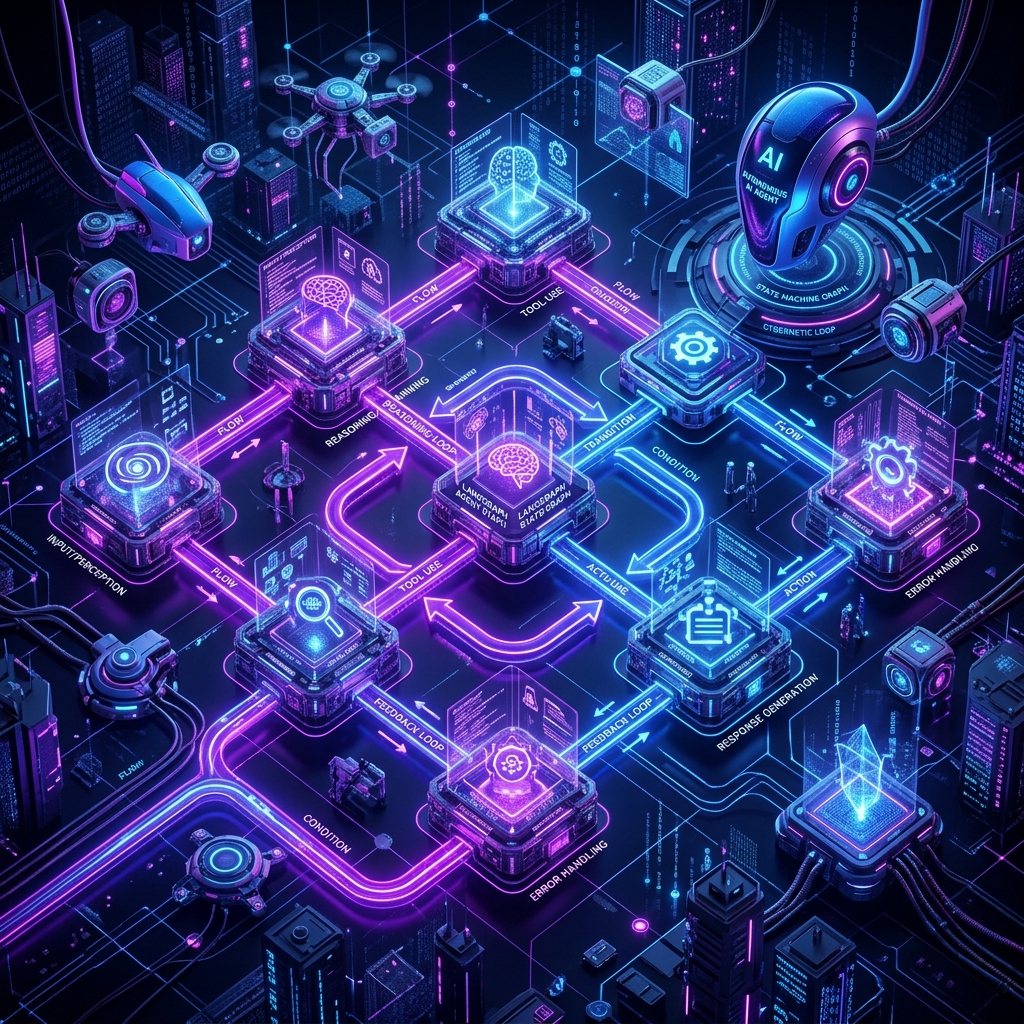
As enterprises move beyond simple RAG pipelines, the focus has shifted to autonomous agent fleets. Discover how to architect, compare, and implement production-ready agent networks using CrewAI, LangGraph, and AutoGen.
In the rapidly evolving landscape of artificial intelligence, simple prompt-and-response interfaces are no longer sufficient to solve complex enterprise problems. Monolithic language model calls fail when tasked with multi-step workflows, long-term reasoning, and handling real-world systems with dynamic conditions. To bridge this gap, organizations are deploying multi-agent systems—collaborative networks of specialized AI agents that interact with each other, consume external tools, and execute workflows autonomously.
However, building a production-grade multi-agent fleet requires more than just connecting models to API keys. It demands a robust orchestration framework that handles memory persistence, cyclic executions, tool integration, and state-machine transitions. In this deep-dive guide, we will analyze the three leading frameworks for multi-agent development: CrewAI, LangGraph, and AutoGen. We will inspect their core architectural models, evaluate their trade-offs, and implement a hybrid framework pipeline built to scale.
1. Understanding the Anatomy of an Enterprise AI Agent
Before comparing orchestration frameworks, we must define what constitutes a functional AI agent inside an enterprise network. Unlike a basic wrapper, a true autonomous agent consists of four core components:
- Cognitive Planning Layer: The agent's decision-making system. This governs how the agent breaks down complex objectives into sequential tasks using techniques like ReAct (Reasoning and Action), Plan-and-Solve, or Self-Refinement.
- Action Space (Tools): The interfaces through which the agent interacts with the physical or digital world. These include web scrapers, database query blocks, internal ERP connectors, payment gateways, and custom API wrappers.
- Memory Architecture: Governing how the agent persists context. Short-term memory tracks active conversations, while long-term memory utilizes vector databases to recall past decisions, user preferences, and historical interactions.
- Role-Playing Configuration: System prompts that define the agent's expertise, constraints, tone, and goals. By restricting the scope of each agent, we prevent hallucination and improve execution accuracy.
2. Framework Showdown: CrewAI vs. LangGraph vs. AutoGen
Each of the leading multi-agent frameworks was built with a different architectural philosophy. Choosing the right tool depends heavily on the level of control, execution speed, and complexity of your business workflows.
| Feature | CrewAI | LangGraph | AutoGen |
|---|---|---|---|
| Execution Model | Sequential & Hierarchical Tasks | Stateful Cyclic Graphs | Conversational & Event-Driven |
| State Management | Implicit within tasks | Explicit State Schema (TypedDict/Pydantic) | Distributed across agent instances |
| Customizability | Medium (Opinionated structure) | High (Total control over execution flow) | High (Ideal for dynamic conversations) |
| Human-in-the-loop | Supported at task levels | First-class citizen (State interruptions) | Interactive prompt integrations |
| Target Use Case | Role-playing content teams, marketing workflows | Complex, rule-based pipelines, billing, support | Group discussions, code generation, simulations |
CrewAI: Pragmatic Role-Playing
CrewAI focuses on ease of use and role-playing configurations. It models agents as members of a "crew" who are assigned specific roles (e.g., Senior Research Analyst, Technical Copywriter) and tasks. CrewAI excels at automating content creation, research, and sequential workflows where roles are clearly defined, and interaction flows from one stage to another.
LangGraph: Deterministic State Control
LangGraph, built on top of LangChain, models agent workflows as state machines. Nodes represent computations (like an LLM execution or database fetch), and edges represent routing decisions. LangGraph is cyclic, meaning agents can execute loops—analyzing results, identifying errors, calling tools, and self-correcting until an objective is met. It is the absolute standard for deterministic enterprise workflows that require strict compliance guardrails and human validation checkpoints.
AutoGen: Dynamic Conversational Streams
Developed by Microsoft, AutoGen is built around the concept of agent conversations. Agents can communicate dynamically, passing messages back and forth to solve a problem collaboratively. It is ideal for complex simulations, collaborative software engineering (where one agent writes code, another runs it, and a third audits errors), and scenarios where the execution path cannot be predefined.
3. Blueprinting a Multi-Agent Network Architecture
To implement a production-grade system, we must establish a clear architecture. Let's design an automation system that processes incoming customer requests, performs technical analysis, executes database operations, and logs notifications.
Our system consists of three specialized agents operating inside a unified state machine:
- Triage Agent: Parses incoming support tickets, determines user intent, and checks the database for billing status.
- Database Operator Agent: Resolves standard data operations, updates customer subscription states, and initiates refunds.
- Quality Assurance Agent: Audits the draft response to prevent data leaks or compliance violations before notifying the client.
4. Code Blueprint: Implementing a Hybrid Multi-Agent System
In enterprise scenarios, combining frameworks yields the best results. We can use LangGraph to define the strict high-level routing graph, and delegate the execution of specific nodes to a highly collaborative team of CrewAI agents.
Here is the complete implementation of a production-grade, state-managed execution node that combines both frameworks:
5. Hardening the System: Security, Guardrails, and Human-in-the-Loop
When deploying AI agents in production, you must establish security mechanisms to prevent models from causing financial or reputational damage.
Prompt Injection & Hallucination Shields
Agents must validate inputs and outputs. By establishing validation microservices, we audit every outgoing prompt and incoming tool argument. Models are blocked from executing direct system commands unless they pass a strict sanitization parser.
Human-in-the-Loop Checkpoints
For critical actions (e.g., executing database mutations or sending customer invoices), the graph execution is halted. LangGraph's persistent state storage allows developers to insert breakpoints. The state is serialized to a database, sending an authorization event to a Slack channel or internal administration panel. Once a staff member clicks "Approve," the graph deserializes the state and resumes execution safely.
Enterprise Security Standard
Never allow autonomous agents to execute direct write queries without human confirmation. Build explicit state authorization steps to secure your application architecture.
Closing Thoughts
Orchestrating autonomous AI agents represents the next frontier of digital transformations. By picking the right framework balance—CrewAI's fast role-playing setup combined with LangGraph's deterministic graph states—your engineering team can build resilient business processes that run autonomously and adapt to dynamic real-world conditions.
Looking to deploy custom AI Agent networks inside your enterprise workflows? Reach out to WebNex's AI engineering team to architect your production integration.